Tuesday, May 06, 2014

Day 1 and 2

This is actually day 18: we're in Oban: this is our second day here, and tomorrow we go to Glasgow.

But let me back up, and start at the beginning.  On April 18th we flew to Paris, via Hong Kong.  Arriving at Paris CDG we retrieved our luggage and completed the (trivial) entry procedures.  I wish it was this painless every time I have to enter the USA.  Our itinerary included a complimentary limousine transfer, and the driver was waiting in arrivals.  He took charge of some of the luggage (we have a lot), and led us to his car.  By putting one large case in the front seat, everything was loaded, and he drove us to the hotel, telling us a bit about Paris on the way.

We arrived at the Mandarin Oriental in the Rue Saint-Honore early on the morning of the 19th, and of course our room was not ready, and not likely to be ready before 3PM.  The hotel kindly gave us breakfast, and we left our bags with the concierge and went out for a walk.  First we walked to the Place Vendome, which is near the hotel, and then we walked through what seemed to be a small temporary street market, with fruit and fish stalls, just in a side street.  We made our way to the Tuileries Gardens, and walked nearly to the Louvre, and then around to the Seine, where we could see the Musee Orsay on the other bank.  After that, we walked to the Passage du Grand Cerf, one of the old covered arcades of Paris.  From there we walked back towards the hotel, and wandered into the Rue Montorgueil, which is an open air market: the produce looked fantastic, great counters full of cheeses, beautiful fruit, meat, patisseries, chocolate and just about any other food substance you can name.

After this we found a cafe and got some lunch, and then since it was about 2PM we went back to the hotel.  Our room was ready, so we checked in, got cleaned up and had a rest.  We had dinner in the hotel and slept the sleep of the jet lagged.

Feeling much better the next morning (Sunday), we went to the Louvre.  I had ordered Paris Combo passes, which I would recommend to anyone.  The passes allowed us to jump the queue of people waiting to buy tickets, and to walk straight in.  We used these passes all over the place, and while they probably did not save us money they saved us an enormous amount of time: what would you rather do on holiday - stand in a queue or have fun?  The passes included metro tickets and various other benefits, and were delivered to our hotel.

Back to the Louvre: it is enormous, and you cannot see it all.  I'll bet there are people working there who have not seen it all.  It is a beautiful building, steeped in history, quite apart from the amazing collections that it houses.  We saw the "History of the Louvre" exhibits, and then concentrated on the Egyptian and Greek exhibits.

After a couple of hours we felt that we had seen all that we could absorb for one morning, so we walked to Place de L'Opera and got lunch in a convenient cafe.  From there we went to the Grand Palais, which is a beautiful building and walked around in the sun for a while.  Then we went back to the hotel and got ready for dinner, which I had booked at Atelier Joel Robuchon Saint Germain.  I must admit to being a little disappointed in this meal.  Steve and I have been to Le Chateau de Joel Robuchon Tokyo in the past, and we hoped for something similar in Paris.  What we got was a restaurant attached to a hotel, very crowded, with people allowing their children to play games at the table and considerable noise.  The food was good, but the ambiance was rather awful.

Sunday, April 13, 2014

Around the World in 43 Days: The Grand Tour

It used be common practice for well-to-do young men to undertake a cultural tour of Europe as part of their education - this was commonly known as a "Grand Tour".  And I know many people who have taken a gap year (or two) and travelled before starting tertiary education.  Steve and I both went straight from high school to university, and from there almost immediately into the work force.  We've both traveled a bit, but not as much as we would like, and far too often the travel we have done has been for work.  This year we plan to do some travel for us: the trip starts on April 18th, and ends (if things go according to plan) on May 30th.

Now in Jules Verne's classic novel, 'Around the World in 80 Days', Phileas Fogg makes a bet, during a card game at the Reform Club, that he can circumnavigate the globe in 80 days.  He then finishes his game of whist and walks home, where he tells his servant to pack a few garments.  Then he gets some money from his safe, and starts his journey at 8:45PM the same night.  So his planning time is, at best, an hour or so.

Steve and I are going to circumnavigate the globe in 43 days, and the planning has taken over a year.  I would like to thank Melissa Louison, Meagan Patmore and Tahn Lee, all of the American Express Travel and Lifestyle service team, for their assistance in the organisation of the whole thing: we couldn't have done it without you.

We are now less than 5 days from the start of the trip, and I have lists of things that must be done, acquired or packed before we leave.  The dining room table is covered in photographic equipment, as we try to decide what to take and what to leave. Steve is practicing his high school Italian and I am trying to recall any of my high school French (not my best subject).  There is a stack of guide books in the lounge, and a mountain of kitty litter in the garage: our cats' nanny will come in to care for The Hoard while we are away, and I have to leave plenty of supplies on hand.

The itinerary, in rough outline, is:

  • Fly from Sydney to Paris (via Hong Kong).  5 nights in Paris.
  • Travel from Paris to Venice on the Venice-Simplon Orient Express.
  • Stay in Venice for three nights and then go to Udine (Oooh-din-ay), probably by train.
  • One night in Udine, then back to Venice for one more night.
  • Fly from Venice to Newcastle, where we collect a hire car.
  • One night in Newcastle, then drive to Brampton in Cumbria.
  • One night in Cumbria, and then drive  to Inverness.
  • Two nights in Inverness and then drive to Oban.
  • Two nights in Oban and then drive to Glasgow.
  • Two nights in Glasgow and then fly to Belfast.
  • Two nights in Belfast  and then drive to Ballymena.
  • Three nights in Ballymena and then drive to Enniskillen.
  • One night in Enniskillen and then drive to Dublin.
  • Four nights in Dublin and then fly to New York.
  • Five nights in New York and then fly to Los Angeles.
  • Four nights in Los Angeles and then fly home to Sydney.
We don't intend to travel as Phileas Fogg did, oblivious to the countries through which we pass and focused solely on the completion of the journey.  Our journey will be interspersed with visits to museums, art galleries, monuments, ruins and anything else that looks interesting.  None of it is being done "on the cheap".  Some of it is being done on the "quite astonishingly expensive".  Reservations have been made at some world-renowned restaurants along the way, and none of the hotels have been selected because they are economical.  I like nice hotel rooms, and consider them an integral part of a good holiday.

There will be lots of photos, some of which will be posted to Flickr, and I shall try to update this blog from time to time.  Stay tuned for further updates.


Saturday, November 30, 2013

Very Long Silence

I can't believe that it has been over a year since I have posted anything, and yet I can.  It has been a very, very busy 15 months: there have been good times, bad times, stupidly busy times and a great deal of travel.  There has not been enough time to blog.  However, right now there is a lull, so let's catch up.

The latter part of August 2012 was consumed by a large Request for Proposal for a finance institution.  These things are a regular feature of life in my industry, and this one was about as much fun as every other one I have ever done.  It involved a great deal of hard work, and the outcome was disappointing, though not unexpected (well, I wasn't surprised, though I think the sales team were). September through November were busy but unremarkable.

In early December I went to Macau (via Hong Kong) for a company conference.  I got a day in Hong Kong, which I enjoyed: a little shopping and a walk through Hong Kong Park.  Here are some pictures taken in the walk-through aviary:


You would hardly know you were in the middle of a city as busy as Hong Kong.

Then I went on to Macau.  I had never been to Macau before, and I managed to get a day to actually walk around and look at it as a place.  The casino part is what you might expect: garish, vulgar and slightly tacky.  Look at this:


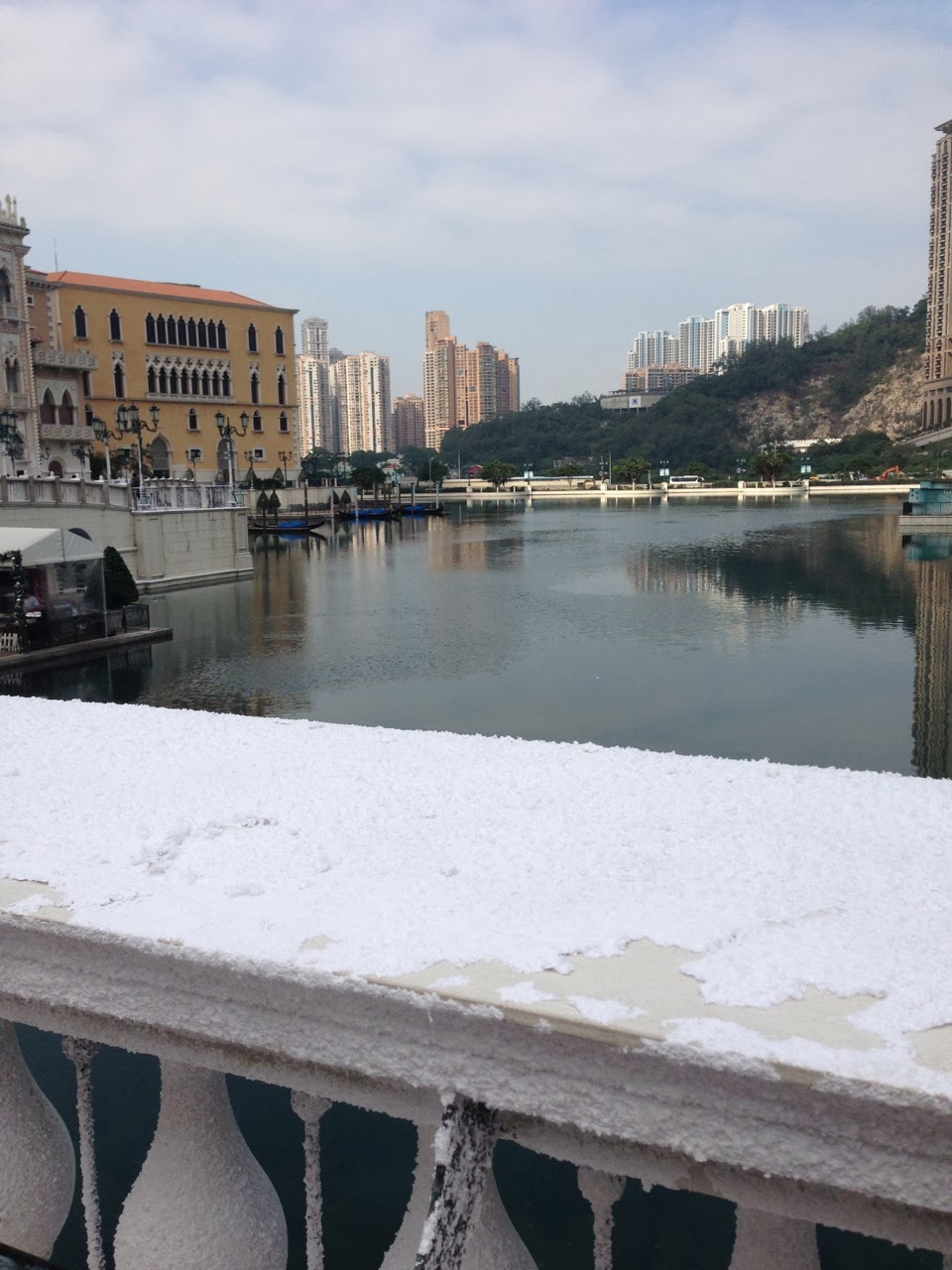
Yes, it looks superficially like Venice, but it's actually Macau. This is the facade of the Venetian Hotel.  They were determined to have Christmas with all the trimming, so there was fake snow everywhere:


That white stuff in the foreground is some sort of spray on "snow effect", and it had been sprayed everywhere.  I hate to think what it's made from.

The conference was good, though the hotel (the Sheraton), and the hotel's food were appalling - apparently the place was in some sort of "soft opening" state, and everything was amateur in the extreme.  Fortunately I only had to stay a few nights.

I got back to Sydney, had a couple of days to repack, and then we went to New Zealand.  Steve and I flew over together, and met up with Steve's Mum, who had flown over from Western Australia.  We had 3 marvellous weeks together, during which we saw things like Hobbiton, 


Rotorua's boiling mud pools, 


the art deco city of Napier, quite a few wineries and the glow worm caves at Waitomo.  We had Christmas in Wellington, and we spent a night in the Hobbit Hole room at Woodland Park.  We finished up by flying to Melbourne to catch the penultimate performance of "A funny thing happened on the way to the forum" with Geoffrey Rush as Lurcio.

Then, alas, we had to go back to work, and there was lots of it.  And then, in mid April, Steve's Mum died very suddenly.  She was 76 and, so far as we knew, in excellent health.  There was the sad business of sorting out personal effects, packing things to be kept and disposing of things that none of the family wanted.  Arranging a funeral, contacting people who might not have heard.  I am so glad that we had that last holiday together, so our last memories are happy ones.

Then there was more work, a massive Request for Proposal from a key customer.  It consumed my life for weeks, and we won it.  Unfortunately, I'm not allowed to discuss it.

I had to make three trips to the USA during the year, visiting Dallas, New York, Raleigh (North Carolina), Waltham (near Boston), Los Angeles and Sunnyvale/San Jose, so I have certainly racked up the air miles.

And now, as the year winds down, we are planning next year's trip, which we are calling "The Grand Tour".  I shall save the details for my next post.


Friday, August 17, 2012

Upgrade weirdness

I've recently been upgrading my Macs to Mountain Lion, and I hit one particular problem that may be relevant to someone else.  When I upgraded my Mac Book Pro, everything appeared to be fine - and then I noticed that when the screen saver cut in, the password lock was not activating.

Inspecting the System Preferences - > Security & Privacy dialogue revealed that the check box of "Require password after sleep or screen saver begins" was greyed out.  Everything else in the dialogue worked as expected, but not that.  I tried the usual things - log off and on, reboot, etc. - to no effect.  One thing that I did notice was that if I tried to set account password to blank from this dialogue, I got a message that said "Your password did not meet the requirements specified by your server administrator..".  This struck me as odd, and pwpolicy revealed no specific policy settings.

Eventually I called Apple support, and spent about 90 minutes with them, with much deleting of preference files, resetting of ACLs and many reboots.   The check box remained stubbornly greyed out.  Apple support stated that the problem was likely to be a third party application, and delicately suggested a reinstall.

I thought about this, and decided that it made little sense.  I run essentially the same applications on all my machines, and only the Mac Book was experiencing a problem.  The password requirements error message struck me as significant, and it occurred to me that, in the past, the laptop had been joined to an AD domain.  I believe I have stated before that, every time I am compelled to interact with Microsoft products, I have bad experiences;  how one company can have unleashed so much truly nasty software on the world and still made a profit defies understanding.

Other accounts did not present the same problem, so, working on the theory that AD had in some way corrupted the user account, I decided to try something.


Login as root, and start Terminal.

mv /Users/myaccount /Users/myaccount.backup

Go into System Preferences and delete the affected user account.

Recreate the user account.

Go back to Terminal.

mv /Users/myaccount.backup /Users/myaccount

chown -R myaccount /Users/myaccount

Log out as root.

Login as myaccount

Problem solved.  If you are going to do this, be VERY CERTAIN that you have a good backup before you start.

Wednesday, July 25, 2012

Outnumbered.....

After Mungo died, it rapidly became obvious that our surviving cat, Percy, was not going to cope with being on his own.  He became increasing clingy and demanding, and for a cat who already thought he was the centre of the universe, that's saying something.  When he began getting weird about going outside unless one of us went with him, we knew we had to do something.  So I called our vet, and asked for his recommendations about what sort of cat would stand the best chance of integrating with Percy.  Our vet knows Percy well, having cared for him for 14 years, and he recommended getting a younger cat, about 4 months old: out of really silly kittenhood, but too young to look threatening.  And so I began the search for a 4 month old female kitten to join the family.  Of course, there were none.  I called every pound and cattery, all the reasonably local vets: no joy.  Older cats, younger cats, but no cats around 4 months old, of either sex.

Meanwhile Percy was driving us both nuts, and putting on weight because he was comfort-eating.

I dropped into the vet's office late one afternoon to pick up some supplies, and mentioned to the girl on the desk that I was looking for a 4 month old kitten, and she informed me that they had two out the back, who had been handed in as strays.  She went to fetch one, and came back with a little calico persian cross, who turned out to have a purr like a motor.  Then her sister was brought out, also calico, but short haired.  Short hair seemed calmer, so I said I would take her, took a photo with my iPhone, and arranged with the vet's assistant that they would call me when candidate kitten was ready for collection.

Went home.  Showed the photo to my husband.  Talked about it.  Called the vet.  Said we would take both.  Not quite sure how we talked ourselves into it, but it seemed like a good idea at the time.  I picked the girls up from the vet on July the 14th, and we are still trying to convince them that we are not threatening.  They are getting better, but we've missed the crucial 3-7 weeks old window, when kittens are pretty easy to socialise.  They are both litter tray trained and very clean, so we are guessing that someone's pet cat had kittens, and these two didn't find homes easily: they've had some handling, but not enough to be comfortable with people.

Percy has not yet met them, though he has grumbled at them under the closed dining room door, and seen them through a window.  He's not exactly happy, but he seems calmer just because there is something else living in the house - he's not alone all day.

So here they are:


Matilda of Flanders, or Tillie for short.

And Florence Von Sass Baker, Flossie to the family:


Right now they are under my desk, behind the printer.  They've spent the day playing wildly all over the north end of the house, and they're probably exhausted.  If we can just get them comfortable with us, we can try introducing them to Percy.  Wish me luck!

Saturday, June 23, 2012

A Death in the Family

On June the 6th my beloved ginger cat, Mungo died at the Sydney Veterinary Teaching Hospital at Camperdown.  Mungo was, we think, a few weeks short of his 15th birthday, and while we had noticed that he was slowing down, the end, when it came, was very sudden.  He seemed slower than usual on Monday evening, but ate his breakfast on Tuesday morning.  However, when I came home - fortunately a bit early - on Tuesday afternoon, he was obviously unwell, and I took him to our vet.  They admitted him, and called at 8PM to say that he had a build up of fluid on his lungs, and that he should be transferred to the teaching hospital if we wanted him to have overnight care.

Steve and I collected Mungo, now with an intravenous drip bag attached, from our vet, and drove to the university.  The folks at the university did everything that they could, but when the pathology work came back on Wednesday afternoon, the diagnosis was carcinoma.  They called me just as my last webex of the day was ending, to tell me that there was nothing that they could do.  I called Steve, and we each made our way to the hospital to day good bye.  I took some cream, and Mungo was still well enough to lick a bit from my fingers: he always loved dairy products.

We were able to stroke him and talk to him, and then the attending vet injected the lethal dose into his intravenous line, and he was gone in a few seconds.  The autopsy report confirmed carcinoma, involving both lungs, which apparently explains some of problems that were treated earlier in the year.

We are both a bit shattered, and Percy, the surviving cat (aged about 14) is beginning to accept that Mungo is not coming back.  Percy has never been alone, and we are hoping that he will adapt: because he is so territorial (and violent), we are not keen to try to introduce another cat into the house - it would just traumatise everyone, including the new cat.

I've disposed of Mungo's favourite cardboard box (the latest of many), donated the special diet food that he will never eat to the vet, and notified everyone who knew him.  He had quite a fan club, for a cat.  Several people have sent me sympathy cards (I didn't know that there were sympathy cards for the loss of a pet), and I am getting into a routine that does not have Mungo in it.  Pets get so intertwined in your life, the hole that they leave seems enormous.

So now my gorgeous ginger fluffer is reduced to ashes, contained in a rather twee little urn adorned with a paw print motif.  We'll pick a sunny day one weekend, and scatter the ashes in the garden.  But I don't want to remember the tired old cat with an oxygen tube up his nose and an intravenous line in his foreleg.  I want to remember the happy kitten who would leap into the bathroom sink, to play with the water coming from the tap.  The regal ginger puss who liked to sit in the fork of the tree on the east side of the garden,


or go out onto the gallery above our family room, and stick his head through the railings. The cat who would wedge himself into a box, no matter how small.


The cat with no dignity


and a tendency to try to hide under furniture...


...if he could find anything big enough.

I adopted Mungo from the Animal Welfare League refuge in August of 1997.  He was named after Mungo Park, the 19th century Scottish explorer who was the first European to see the Niger River.

I shall miss him terribly.


Wednesday, May 23, 2012

Ancestors

What a sink hole of time is genealogy.  You tell yourself that you will just have a quick look, figure out who your great-great grand parents were, get a bit of a sense of the family history.  Then the next thing you know you are spending your spare time transcribing 19th century church records into spreadsheets, so that some reasonable level of correlation and analysis is possible, and chatting to other researchers about interpreting really difficult handwriting.

And I mean bad: I've worked for doctors and lawyers, and they are not even in the running for illegibility compared to some of what I've dealt with recently.  Between the erratic spelling of place names - some of which are pretty strange to begin with (Hurtletoot, I'm looking at you), the splotches and smears caused by old fashioned ink pens, and the extremely indifferent handwriting of people who had little or no formal schooling, and you begin to look forward to the entries where the officiating minister wrote all the names, and everybody else just wrote an "X" next to the words "his mark" (or "her mark").

However, the marriage records make interesting reading.  You can follow the changes in occupations - almost none of the brides had occupations before about 1955; after that, few of them didn't have an occupation, unless they were very young.  And the change in given names is interesting - in the early records they are all James, John, Mary, Margaret, Archibald, Alexander, William, Elizabeth, Annie, Jeannie; but 1965 there are people called Stanley, Gerald, Nancy, Pauline, Dora, Josephine.  The big change comes at the beginning of World War II, when there must have been soldiers and airmen stationed near the town I am working on, people from other parts of the country.  They started marrying local girls, and in quite a few cases it appears that a brother or sister who attended the first wedding met someone they liked while they were there, and a few months later there would be another wedding.

And the men's occupations change - originally the men were all farmers or worked in the flax mills, or as weavers.  Slowly engineers begin to crop up, school teachers, chemists, business managers, lorry drivers, even a detective.  People began to live longer, and marry later.

The end is in sight: two volumes of marriage records to go.

Tuesday, November 01, 2011

.....And we're back!

The last few months have been ridiculously busy for me, and I haven't updated this blog since late May. However, things have settled down a little, and I'm going to try get back into the habit of blogging (also of exercising, and few other things that I've been a bit slack about lately).

The key events, and things that took up the time:

Editing a book: The First Donegore Story, by Donald Alexander, is out and available from Lulu. I'm really pleased with the result, and the finished book looks good - if you have never used Lulu, I'd recommend them. The final bit of work was the cover.

This was constructed using images from the book, the cover of an ancient dictionary that I have in my study, some old paper from a handwritten recipe book that belonged to my grandmother, a scanner and extensive Photoshopping. I'm sure a professional graphic artist could have done better, but I was satisfied with it as my first foray into the field. It was a lot of fun, and I learned a few things doing it, particularly about handling very large documents in Microsoft Word, and about Photoshop.
The official launch of the book is next Tuesday: if you happen to be in Donegore, the details are here.


I changed jobs: I now work for NetApp. Starting this job has been a bit like coming home: the office is right across the road from the building that I worked in while I was with Sun Microsystems, and many people who I worked with at Sun now work for NetApp.

Steve and I also had a three week holiday, two weeks of which we spent in Japan and Singapore. We had organised the trip to celebrate our 25th wedding anniversary, and we had a fantastic time. The weather was good (mostly, better than we had expected), the hotels were lovely, the people were nice, and we saw (and took photos) of all sorts of things, from Himeji Castle to the Marina Bay Sands Hotel in Singapore (Steve wants to stay there next time). A small selection of our photos is on Flickr: Japan here and Singapore here.

American Express made all the travel arrangements, and they appear to have told all the hotels that the trip was for our wedding anniversary: all three hotels (Park Hyatt in Tokyo, Hyatt Regency in Kyoto and Mandarin Oriental in Singapore) made a special effort to help us celebrate. Flowers, special deserts, personal greetings (and wine!) from hotel managers: it was great, and made the whole holiday extra special. We went to Chateau Restaurant Joël Robuchon for our anniversary dinner (which was fantastic); the Park Hyatt sent a photographer to our room to take our photo before we went: then they presented us with the mounted photo as a memento the next day. On the morning that we left Singapore to fly home, the restaurant staff served us champagne with our breakfast. All nice touches and lovely memories.

However, we are now back at work, and on the run up to Christmas. I'm establishing a routine in my new job, and preparing to get started on my next personal project: the creation of a map of Sydney "underground", using the floor plans of all the interconnected shopping centres and arcades. If you spend a lot of time in the city, you work this out from personal experience, but for people who only visit occasionally all the convenient short cuts are a mystery. I've drawn enough maps for imaginary cities in FRP campaigns, I should be able to draw one for Sydney.

Sunday, May 22, 2011

Count down.....

Finally, after years of rumours and delays, June Hemmons Hiatt's "Principles of Knitting" will be reissued in November. It's available for preorder at Amazon, and at The Book Depository (and probably other places). TBD says there are 163 days to go, so I must mark my calendar.

Second hand copies of this revered work have traded at frankly absurd prices for years, if they are available at all - I've never even seen one. The existence of the book is like a cherished myth, passed from knitter to knitter in yarn shops and at craft fairs. Apparently the new edition is a complete rewrite, to cater for modern fibres. I hope it's worth the wait.

Friday, May 20, 2011

So much to do, so little time....

I've had a busy few months, but this evening my wonderful husband is cooking dinner, and I have time enough to blog.

I have once again over committed myself. I have not yet completed the project to scan all my back numbers of Omni magazine (though the end is in sight), and despite that I took on another large project. I am editing (and designing) a book about the history of a Presbyterian church in Northern Ireland. I am also knitting, with yarn backed up waiting for the needles to be free so I can start the next project, trying to read several books at once, and trying to change jobs. I need more hours in the day, or days in the week.

The history book was an unexpected opportunity. I've been researching the history of my late father's family (family history - there's another sink hole for time), which is extraordinarily badly documented. In the course of dredging through the online resources, I stumbled across the First Donegore Presbyterian Church website. One of the church members kindly sent me their baptismal records: hundreds of pages of photographs of hand written records stretching back to 1806. As soon as I saw the first pages, I knew that I would have to do something to make the records more accessible: finding anything in them in their raw state would be extremely challenging. So I said "I'll get the whole lot converted to a spreadsheet", and they kindly sent me a draft of their church history as well. I had a look at the document, and it brought back fond memories of cataloging family history for the National Library of Australia: erratically formatted documents with amateur-hour illustrations and no indexes. We used to get scores of these things, under Legal Deposit requirements, and their sole virtue in my eyes was that I could catalogue half a dozen in an afternoon (the subject headings and Dewey numbers would be almost identical for every one, leaving only physical cataloguing, which isn't that time consuming) and keep my daily averages up. We aimed to complete 8 books a day: cataloguing takes a lot of time, and we were still doing hand written coding onto data entry sheets when I was at the NLA.

So I outsourced the baptismal records to Freelancer, and got stuck into the book itself. I've thoroughly enjoyed it - it is actually much more interesting than it sounds. Social history, about people rather than war or politics, has always interested me, and I hope that the lecturers who taught me history at university would approve of my efforts. I actually read Irish History in my third year, and I still have some of my text books, which has proved useful. We hope to publish in August.

Then there is knitting. I'm part way through an interesting cowl, and then I saw the Mr Fox stole in an issue of Yarn Forward. Even my husband, who is normally immune to knitting patterns, concedes that this one looks like fun. And I still have a bag of Noro yarn (and a pattern for same) from my Christmas trip. I need to knit faster.

And I need to change jobs. This is by mutual consent with my bosses. Things didn't go as we expected: while there is plenty of work, it is not work that I am particularly good at, so it is everyone's best interests that I move on. And now is the time: the amount of work out there is staggering! I've got a couple of interviews lined up next week, but as word of my availability spreads, I'm getting calls from people who I have worked with in the past who would like to work with me again. This is really nice: it is not that easy to explain what I do on a standard resume, but the people who are calling me have seen me at my best - what one former colleague was pleased to describe as "charging $2,000 a day to fix things you know nothing about". And that is essentially what I have done for many years. I have a career based on saying "OK, I'll have a look at it, come back in a couple of hours and I'll have something for you". I am "the third engineer": if two people have already tried to get something working and failed, I'll come out and fix whatever it is. This not because I know a huge amount about anything - it's because I know a bit about everything, and I'm prepared to take calculated risks.

So I have opportunities with a couple of systems integrators and couple of top tier vendors, and more coming in. Every time I get a call I have to re-evaluate what I want to do next : interesting work versus commute problems versus financial stability versus employer stability etc. Interesting times.....

Wednesday, January 26, 2011

Audrey Blooms

Audrey bloomed last night.

Here she is at about 6:45PM


And about 9PM:


The flower has gone a bit limp now, though may open again tonight. The flowers are usually not as good on the second evening.

Sunday, January 23, 2011

Audrey's Progress

It's been seven days since I took a picture of Audrey. Here she is this evening:


Quite a change for seven days. Here's a shot with a ruler, so you can get some idea of the size of the bud:

Getting a well-focused picture is proving to be tricky, because the garden is fairly breezy - we are near the top of a hill - and I have to wait for a calm moment in order to get a shot where Audrey isn't jigging about. An additional challenge, revealed by the telephoto lens, is the ambient cat hair in the environment. My first shots this evening were compromised by the presence of white cat fluff, courtesy of Percy (AKA Fernslayer).

Sunday, January 16, 2011


Meet Audrey


So this is Audrey


Audrey lives in my back garden


That's her, in the pot. And she is just gearing up to flower. Over the next few weeks, that small bud will get much larger - and if we are lucky there will be more than one. Last year, Audrey produced three flowers, each lasting only one single night. I'm planning to take pictures several times each week, and hopefully get multiple pictures on the critical "flowering night".

Audrey is the product of my mother's dreadful habit of souveniring cuttings out of other people's gardens (I just cringe, and pretend that she is nothing to do with me). When she first handed me the rather unprepossessing bit of stalk and leaf, I had my doubts. It didn't look like anything that I wanted to cultivate, and my gardener said "stick it in a pot: then if you don't like it, it's easy to get rid of it". The plant still doesn't look like much: it's primitive and rather straggly. But the flowers are worth the effort.

Tuesday, November 30, 2010

What is this?

I took this picture through the window of a plane, flying from Japan to London in March 2004.


I'm guessing that we were somewhere over east Russia.


Update: I asked Reddit, and the answer is: a river with Oxbow lakes. What we call a billabong in Australia. Thanks to utexaspunk for providing the answer.

Monday, November 22, 2010

Drip feed network

Did you ever here the old saying "the cobbler's wife goes barefoot and the doctor's wife dies young"? Well in my house, the person who gives other people advice on keeping their infrastructure up to date has failed to keep her own infrastructure up to date. Specifically, I have failed to maintain our household internet connection in line with our usage. As a consequence, we are on rationed internet usage for the rest of this month.

I blame Steve Jobs for this, because I am pretty certain that it was downloads from iTunes that maxed out our quota, though it is not entirely his fault. Our current (note that word) ISP is Optus, the local minion of the larger Singtel group. Some time in 2002 I had an Optus cable modem installed, and the data plan in place today is what Optus is pleased to call 'Unlimited Pro'. This plan is in no way, shape, or form unlimited: what it actually provides is 20GB per month of peak hours data, and 20GB per month off peak (where peak is noon to midnight). When it first went in, this was fine: the service was fast, and the possibility of an iTunes store in Australia was but a glint in the Jobsian eye - and I didn't even have a Mac in 2002. However, the years have passed, Mac have proliferated all over my house, there is an Apple TV in my family room, my husband (who is still in thrall to Microsoft) has also discovered iTunes, and online gaming and online shopping, and our data usage has gone through the roof. Meanwhile, more people are now using the Optus cable service, and on some days it is so slow that it is next to unusable. What I think happened in this instance is that one of us (probably me) kicked off a download from iTunes in the off peak period, and it took so long to complete that it slid into the peak period. So I checked our usage last week, and discovered that we have less than 1GB of peak data left between now and the end of November. If we use more than that, Optus throttles our link to 64kbps for the rest of the month. We have experienced this before, and it is not fun.

And I can't upgrade the plan - this is the best that Optus can offer - and I can't just give them money to make the problem go away.

So right now, we have Internet access in the mornings - we still have plenty of off peak data available. In addition, I have bought a Pocket Wifi from Vodaphone: it came with 3GB of data, and it works beautifully, so I can get online in the afternoon if I really need to do so, and of course I have my iPad and its 3G connection. And I am taking steps to get rid of Optus, and to replace them with an ISP who offers more flexible data plans. My choice is iiNet, and I'm hoping that they live up to their reputation for competence and good customer service. The first thing I need is a new standard phone line: that is supposed to be installed tomorrow.

I had intended to deal with this earlier. I had actually ordered a new firewall - which is now languishing on the dining room table, because I don't want to waste our limited bandwidth setting it up. I just didn't act quickly enough.

Still, I wasted less time on random browsing this weekend.

Monday, November 01, 2010

The Other Project

I've had some complaints lately about the infrequency of updates. I know things have been a bit quiet, and this is because I have been working on something else. In fact, on a completely different web site.

Do you remember Omni Magazine? It was published between 1978 and 1995 - so you have to be of a certain age to have encountered it - and it featured wonderful artwork, groundbreaking fiction and a rather variable level of commentary and reporting. Quite serious science reporting was intermingled with hilarious nonsense and crack pot theories. Viewed today, it provides an interesting commentary on a period in history - there are far more tobacco ads than you would see in any current American publication . You can trace the diamond industry's carefully orchestrated campaign to convince people that two month's salary is a reasonable amount to spend on an engagement ring. There was a wonderful series of ads from the International Paper Company, called "The Power of the Printed Word", each ad a two page spread on a subject such as "How to read faster" or "How to use a library". The fiction published in Omni included William Gibson's "Johnny Mnemonic", Harlan Ellison's "Mefisto in Onyx" and stories by Isaac Asimov, Orson Scott Card and many, many other notable authors.

I don't recall when I first encountered Omni - I know that I bought it regularly for much of its life, because many the copies I have still have the newsagent's reservation stickers on them, the early ones with my maiden name written on them, the later ones with my married name. However, some numbers I acquired second hand, to fill the gaps: all the early numbers seem to have come from a university fund raising book fair.

I have a full set now (I filled the last few gaps from eBay), but the paper is beginning to degrade. The company that originally published Omni is long gone, and whatever copyright still exists appears to reside with either the original authors of the material, or with Friendfinder Networks. I can't envision any way in which Omni could be reprinted, so eventually it will probably disappear. This seems a pity: if some entity like Zinio could get the rights, they could reissue Omni to an enthusiastic audience. Omni has many fan sites, and its own Facebook page. But I don't see this happening, because of the copyright issues involved. So a friend and I are scanning the whole lot, as well as we can, so at least there will be a soft copy that we can refer to when the paper copies become unreadable.

Scanning magazines is time consuming, and as a side activity, I am developing a comprehensive index. The fiction component has been indexed in the past, but not the whole contents. If you check the Facebook page, you will find many people who can remember something that they believe that they read in Omni, and which they want to find again. Searching 200 issues is impractical, and lot of requests could be satisfied by a decent index. However, manual indexing is labour intensive, and I'm being hampered by the fact that some of the artwork is not credited. So a lot of my free time has been going into scanning, indexing, and creating a web site where I can store the basic tables of contents and author indices. The detailed content indices will take months to complete (an issue takes about 3 or 4 hours to completely index). If you want to have a look at what has been done so far, the site is The Complete Index of Omni Magazine.

Sunday, October 31, 2010

Vendor Swag

Last week I had the pleasure of spending two days at VMware's vForum 2010 at Darling Harbour. It was a great event, particularly since I was there as a conference attendee, and not as a company representative. If you have never had to man a booth at a trade show, let me assure you that is very hard work. You try staying on your feet for two days, while being upbeat no matter who you have to deal with, and see how you feel.

I met a huge number of old friends, which is always fun: you get to compare career paths, and since I changed jobs last May, a lot of people were keen to know where I had moved to and why. And the catering was excellent.

However, right now all the "stuff" that I was given to me by various vendors in the course of the event is stacked on my dining room table, and looking through it makes me question the sanity of some company's marketing departments. So what did I get?

First, from the conference itself, a shoulder bag. Nominally a laptop bag, and it would do in a pinch. I used it yesterday to carry my camera and accessories to the city, to shop for a new camera bag. Today, it's on it's way to the attic to join all the other spare bags in the house. I may never use it again, so as brand name placement it's a bit of a dud.

A coffee mug. I have coffee mugs from companies that don't even exist any more. They get used either when I have tradesmen on site, and need to provide hot drinks; or for large social gatherings, when I don't have enough cups. The only vendor mugs that I use regularly are some steel ones that APC gave me a few years ago: they are really nice, and I'm happy to put them on the table. The new one is a mundane white china thing with a logo: it's going into storage in the attic.

A squashy foam ball. Unremarkable, but it will wind up on my desk in my customer-site office, because if you are a naturally fidgety person (such as me) you need things to fidget with while you are thinking.

An object made of a similar squashy foam, and intended to represent a telephone - the office type, with many buttons. Of the vendor who gave me this I can only ask "why"? What were you thinking when you ordered this stupid thing to be printed with your logo? What do you expect the recipient to do with it? I'm either going to chuck it in the toy box that I keep for visiting children, or add it to the pile of missiles that I keep handy to throw at Percy when he is clawing the rug or biting Mungo.

Pad of sticky notes, printed with logo. Always useful, and will go to my main office.

Quite a decent pen, but I have scores of vendor pens: my Mum will probably get this one, since she does a lot of crosswords and loses pens regularly.

A screw-top "test tube" full of red jelly beans. This could have worked, but it doesn't have a logo on it at all. The tube will probably end up in my knitting bag - it looks to be the right size to hold buttons and small tools.

A key ring, the fob of which combines a tape measure and a flash light. I wouldn't use this as a key ring, it's too bulky, but a tape measure is always handy in the office, and a flash light can be very handy in a data centre - some of them are quite dimly lit. I recall once, working in El Segundo, and having to go to the nearest Fry's to buy a flash light, so that we could read the asset tags on the equipment.

A 4GB USB flash drive. Always useful, but this one has a cap that is going to get lost easily, and the rep who gave it to me told me that his marketing people had only provided a couple of hundred (this for a conference attended by 4,000 people), because they cost $20 each. You must be kidding me! A 4GB flash drive, even with three colour logo printing, should not cost more than $15, and half that for larger quantities.

A box of three Lindt chocolates. Nice, but again, there is no logo (other than Lindt's). I don't even recall which vendor gave me this.

A collapsible "frisbee" type flying disk. These always go down well with the folks on the help desk.

The purpose of this type of marketing material is both to lure the prospective customer to your stand for a conversation, and to keep your name before their eyes for days, weeks, and if you are lucky, months to come. Given the amount of money that is spent on conference give aways, I'm astounded at how poorly they are targeted.


Tuesday, October 26, 2010

The iPad, 5 months on

It's now late October, and the iPad has been part of my daily life for almost exactly 5 months. It has turned out to be a perfect fit for me, for a number of reasons:

I work as a consultant, and I spend a lot of time on the premises of large banks. Banks, quite justifiably, will not allow wandering consultants to plug just any old laptop into the corporate LAN. In fact, the bank where I am working at the moment has kindly issued me with a corporate IBM ThinkPad, running the bank's preferred standard operating environment. Unfortunately, their SOE is based on Windows XP and IE6, which is like being summarily dumped back into the last century. One of the (many) reasons that Microsoft has no hope of ever being "cool" is that for a large number of people, their daily experience of Microsoft is not Windows 7, or even Vista: it is Windows XP, and it is old hat. The bank also (quite reasonably) blocks access to some website from within the corporate LAN - for example, Dropbox. However, my iPad does not need to connect to the bank's network, and I can use it to access anything that I need, without hindrance.

I have acquired a few new apps since I first acquired my iPad: Quickoffice, Zinio, Nebulous Notes, Airsketch, Flipboard, Wordflick HD, the Google mobile app and Soulver. All of these are good, solid apps.

However, considering what I use most frequently, I would have to say the following, in no particular order:

The built-in mail app

Atomic Web browser

Zinio

Goodreader

Soulver

Pages

Instapaper

1Password

Dropbox

Evernote

Amazon Kindle

CSV Touch

I do use all the other apps that I have installed, but not as consistently. I take meeting notes directly into Pages. I use Goodreader constantly, to read and manage files. Evernote is installed on every device that I use regularly, as is Dropbox, and I cannot imagine life without either of them. The Atomic Web browser, particularly when combined with Safari Online (see previous post), has simplified my life enormously, because I now have ready access to technical manuals whenever I need them, without have to purchase the physical books. By my reckoning this has already saved me more that the cost of the Safari subscription already, and it has also saved me from buying several books that were not as good as their initial, optimistic, reviews. Instapaper, Zinio and Flipboard always give me something to read, so that queuing time is never wasted.

I took the iPad to Melbourne last month (a brief holiday, to celebrate a wedding anniversary), and it was so much easier than lugging a laptop. I spent today at a conference (vForum 2010), and the iPad didn't weigh down my shoulder bag, but it did do everything I needed. Anyone releasing a device in this category will have to go a long way to surpass the iPad.


Tuesday, September 07, 2010

How do we remember things?

In the mid to late 1990's I had a job that required me to work most of the time on a help desk. Generally I provided second and third level support for technology resellers and integrators, with the occasional exception where I would actually have to speak to an end user. And from time to time I would stand down from the help desk, and go and work for my employer's training department. During these periods I would generally teach for two straight weeks, starting with the general introduction to Unix, and moving on through Unix system administration, TCP/IP, serial communications and shell programming. Two weeks was enough to do the full cycle, and I quite enjoyed teaching. According to my class feedback forms, I was pretty good at it. And there is nothing like teaching a subject to really clarify it in your own mind. I knew my subjects, knew them well. All those obscure Unix command line arguments, the vi editor, the tips and tricks that make all the difference between coping with an operating system and actually managing it were second nature to me.

Years passed (cue falling calendar pages or whatever), and I moved into consulting and then into presales. I dallied with other operating systems. I learned other technologies. And somewhere along the way, I began to forget my old skills.

I've now gone back to consulting (rather joyfully, I don't think I have any great talent for presales work), and a few months ago I began to learn Python. Python is rather a fun language, and I needed to learn it to satisfy the requirements of a customer. I got that job done, having learned enough Python to perform the task at hand but not much more. So I looked around for something else that needed coding: I can't learn a language unless I have something to do with it. Working through the exercises in books bores me to tears: I need a practical task to which the language can be applied.

I found a suitable task fairly easily. A while back there was a reminiscent post on Boing Boing about the old Omni magazine. Now I have a complete collection of Omni, from 1978 to 1995, about 180 or 200 issues. I hadn't looked at them in years - they were in journal boxes in my non-fiction room (shown on the house plans as Bed 4, actually full of book shelves). So I dug them out and had a look. I had forgotten what fun they were. A bit of online research showed that many people recall Omni fondly - there is even a Facebook page - and that it has never been properly indexed. There is a fiction index, but no comprehensive index of the whole thing. There have been some abortive attempts, which appear to have foundered because someone attempted to type every citation in manually, and got bored after the first half dozen issues.

Here's a job worth doing, and actually not that hard. I can scan the contents pages, put them through an OCR process and then write some scripts to reorganize and reformat the output, and to construct an index. Ideal for extending my Python knowledge, and good practice at getting back to the command line, a place that I haven’t spent much time recently.

Now anyone who has ever made much use of OCR knows that it is far from perfect. Particularly on old or degraded print, the recognition can be spotty, to say the least. So as each chunk of text is rendered, I open it up in vi and do some basic cleanup manually. The first few times that I did this, I struggled: I couldn't remember the vi commands to get things done quickly. I was actually trying to learn Python, so I didn't want to have to keep stopping and looking up the vi MAN pages. And then, quite suddenly, it all began to come back. But it wasn't as if I had remembered the keystrokes that I needed - it was if my fingers had remembered. Quite strange. Once I'd entered a command, my brain could analyse it and go "oh yes, I remember that syntax now, and it works like this". Since vi has a very regular command structure, once I got a few commands back into my brain, I could get most of the rest by extrapolation.

There is a scene in Robert Heinlein's novel "I will fear no evil" (if you've never read it, synopsis: extremely wealthy elderly man - Johann Smith - arranges to have his brain transplanted into a donor body. He recovers consciousness to discover that not only has the operation worked, but that previous occupant of the body has not entirely moved out, and furthermore was female -Eunice Branca), in which Johann Smith attempts to play the piano, a skill that he used to have. He can't do it, his new body won't cooperate. Then the "ghost" of Eunice takes over and operates a complicated piece of office machinery that Johann has never used. It works perfectly, because as Eunice says "the body remembers".

I've heard similar things from someone I know who had to learn to walk again after suffering brain damage. His brain knew how to walk, but his body had to relearn the skill (which his said was astonishingly difficult, for something that we take so much for granted).

Anyway, my fingers seems to have remembered all the vi short cuts that my brain forgot, and the Omni index is progressing nicely. I have it on line over here, if you want a look, and I'm hoping for some help with the proof reading.

Saturday, July 31, 2010

My Latest Apple Gadget....

Is not an iPhone 4. I walked down George Street yesterday, and there were literally hundreds of people queuing outside the Apple store, and more large crowds outside each of the various telco outlets between my car park and my office. Some of those people must have spent most of the day queuing. Good lord, some of them had set up camp on Thursday, with sleeping bags and chairs! Don't they have jobs? How on earth does someone with nothing better to do with their time than wait in the street to buy a mobile phone afford a mobile phone in the first place?

Any way, I have already have mobile phone, an iPhone 3G, which is running iOS 4.0.1 perfectly well (perhaps the display of SMS messages is a shade slower since the upgrade, but I have had no other issues/crashes/complaints, and I completely fail to understand all the gum flapping in the press about "iOS 4 rendering iPhone 3G's unusable". Poppycock, etc.). I'm sticking with my existing iPhone until (a) the furor dies down, and I can just walk into a store a get an iPhone 4 without having to queue; and (b) I have enough time to deal with changing phones and telcos (note to Optus: you're dumped). Yes, I know that iTunes will sync all my data and apps from the old phone to the new phone, but I'll still have to negotiating getting off Optus and onto Telstra (my current employer's preferred supplier) without losing my existing mobile number, and then I have to get the new phone re-paired with my car and blue tooth headset, and established as a sync client for various apps. No, it is not going to be a five minute job, and I have a proof of concept kicking off next week, and several other streams of activity that need my attention for at least two weeks. So later for the iPhone upgrade.

The new gadget is one that I bought on Thursday (when it was still safe to go into the Apple store): the new Apple Magic Trackpad.

First, I hate the name. Someone in Apple's marketing department has "magic" on the brain at the moment. Perchance too much exposure to Disney children's classics has induced some sort of overload in the fairy dust department? Whatever, the device itself is really working for me. I've hardly touched a mouse since I got it (well, them actually, there's one in my office as well), which is good, because I still have this wretched tendonitis in my right arm, and using a mouse isn't good for tendonitis. The action of using the Trackpad is quite different, because you don't have to "hold" anything. Just holding a mouse causes the muscles in your arm to tense slightly, and moving the mouse works both muscles and tendons quite a lot. Using the Trackpad requires much less movement, and it's a different movement to mouse movement. Yesterday was a completely mouse-free day, and my arm was better for it.

The Trackpad (I refuse to using the 'M' word) does take a little getting used to, but I've adjusted quite quickly. The only thing that I've had trouble with it is using the Marquee tool in Photoshop for large selections; a Wacom tablet will still be better in Photoshop, no question. Everything else - scrolling, clicking, right clicking, dragging - works perfectly. I do have to be careful not to rest my fingers against the pad by accident, because it does interpret a very light touch as a direct order, and does it's level best to act on that order. The result is usually annoying.

Right now, and until I can get the tendonitis fixed, this Trackpad is the perfect pointing device for me. I think I may find it difficult to go back to a mouse in the long run.


Addthis

Bookmark and Share